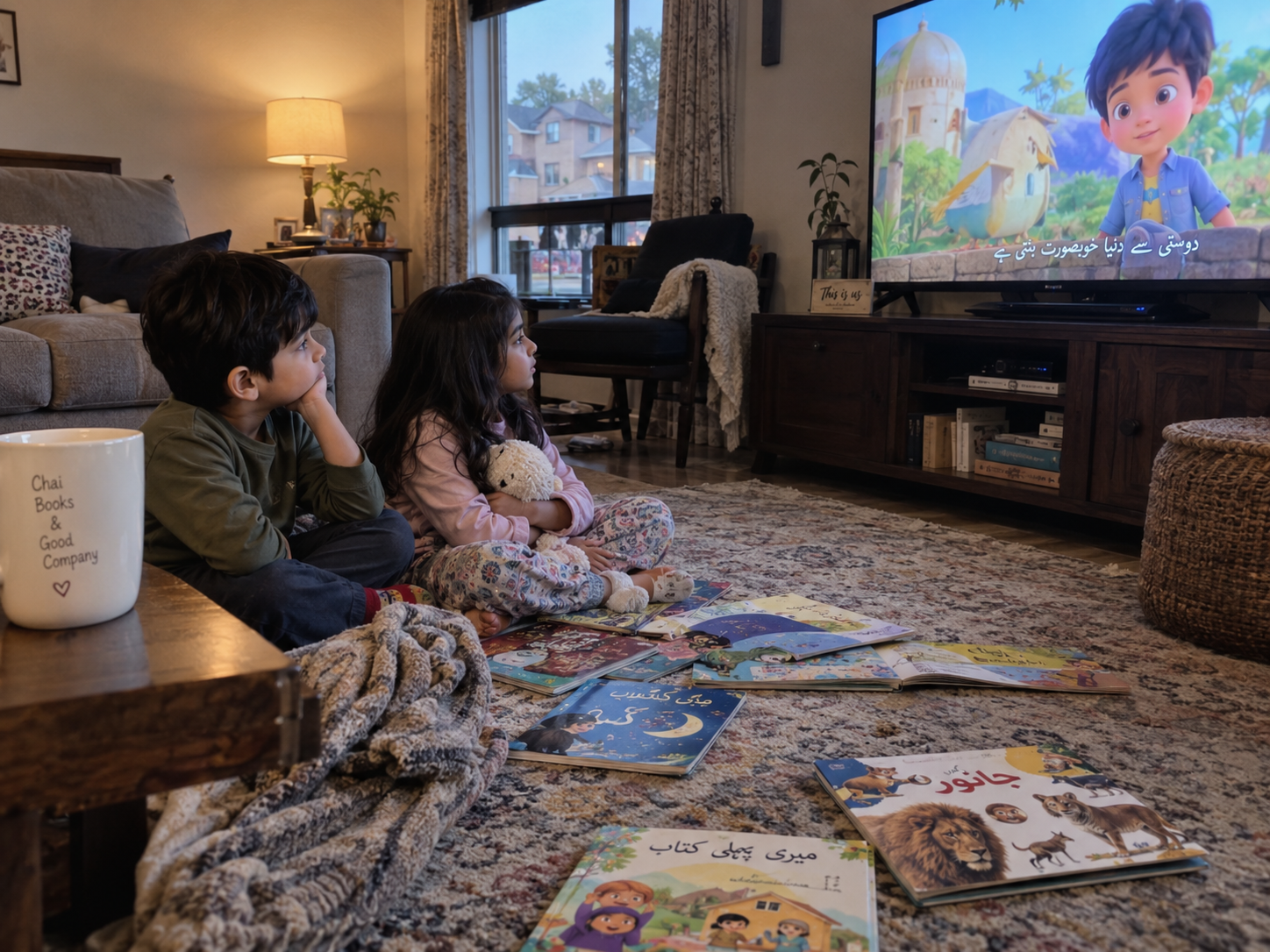
Keep it low pressure
Celebrate effort instead of correcting every word. English replies can still show understanding.
Parent Guide
Practical, low-pressure ways to make Urdu feel normal, useful, and connected to everyday family life.
Start with one small habit. Repeat it often. Build from there.
Start here
You do not need to turn home into a classroom. Keep Urdu warm, useful, and easy to repeat.
Celebrate effort instead of correcting every word. English replies can still show understanding.
Use it for greetings, snacks, help, play, choices, and the little things your family already does.
Five consistent minutes can do more than an occasional long lesson. Familiar language gets easier to use.
Free resource
Try one low-prep guide, or browse the full free Urdu resource library.
View all free Urdu resourcesBuild it into real life
You do not need to do all of these. Pick one idea that matches your routine and open it when you need it.
Build Urdu into real conversations with parents, siblings, and friends.
How: If your child answers in one word, model a longer version and let them repeat it: “Paani.” → “Mujhe paani chahiye.” Keep it gentle and playful.
Why: Sentence practice is how kids pick up grammar without worksheets.
Try this: Use “I want…” and “I see…” sentences daily: “Mujhe ___ chahiye” / “Mujhe ___ nazar aa raha hai.”
How: Create small “Urdu-only moments” between siblings — during play, building toys, pretend games, or simple requests. Gently model short Urdu phrases they can copy: “Meri baari hai”, “Tum lo”, “Idhar aao”, “Chalo kheltay hain”. Don’t correct every mistake — just repeat their sentence back correctly and keep the game going.
Why: Sibling-to-sibling language is powerful because it feels natural, playful, and real — not like a lesson. When kids use Urdu to negotiate, joke, or cooperate, it becomes a living language instead of something only spoken to adults.
Try this: Choose one daily “Urdu sibling phrase” and encourage
them to use it with each other all day. Examples:
“Meri baari” (My turn)
“Tumhari baari” (Your turn)
“Madad karo” (Help me)
“Shabash!” (Well done!)
Praise the effort, not perfection — even one Urdu exchange between siblings
is a big win.
How: If possible, one parent stays in Urdu and one stays in English. If not, choose certain “Urdu zones” (kitchen, bedtime, car rides).
Why: Clear patterns reduce confusion and help kids switch naturally between languages.
Try this: Create “Urdu-only phrases” you always say the same way (greetings, requests, praise).
How: During playdates, sprinkle in simple Urdu directions: “Idhar aao”, “Baith jao”, “Apni baari”, “Shabash”.
Why: Language sticks when it’s used for real communication, not just practice.
Try this: Make one game “Urdu-mode” for 5 minutes, then switch back.
How: Give Urdu a “home” in your schedule: Story Night, Song Saturday, Cartoon Sunday, etc. Keep it light and predictable.
Why: Consistency beats intensity. Small daily habits build big results over time.
Try this: Attach Urdu to something your child already loves (snack time, bath time, bedtime).
Use familiar stories, imagination, and family voices to make language stick.
How: Read the same book for 5–7 days in a row. Use big expression, point to pictures, and pause to ask tiny questions: “Yeh kya hai?” “Kis rang ka hai?”
Why: Re-reading builds “automatic” vocabulary. Kids learn phrases as whole chunks, not just single words.
Try this: Choose one “phrase of the week” from the story and use it at home all week long.
How: Pick any English book and read it “in Urdu” out loud. Try to say everything in Urdu as you go — page by page — even if it’s not a perfect translation. If a sentence is too hard, shorten it. If you don’t know a word, swap in an easier Urdu word, describe it, or use one English word and keep moving. The goal is flow + Urdu exposure, not accuracy.
Why: Your child still gets the story they love, but your home becomes an Urdu environment. Kids learn best from repeated, natural sentences — and they don’t care if your translation is “academic.” They care that it’s fun, clear, and consistent.
Try this: Use these repeatable Urdu “story
phrases” when you get stuck:
“Matlab yeh…” / “Yani…” / “Bas yeh ho raha hai…”
“Phir kya hua?” (Then what happened?)
“Yeh kaun hai?” (Who is this?)
“Woh kaisa mehsoos kar raha hai?” (How does he feel?)
Aim for 80–90% Urdu. If you only manage 50% today, that’s still
a win — keep going tomorrow.
How: Ask your child to draw something, then help them describe it with simple prompts: “Yeh kaun hai?” “Yeh kya kar raha hai?” “Is ka mood kaisa hai?”
Why: Kids remember words better when they are attached to their own imagination.
Try this: Turn drawings into a “mini book” and re-read it weekly in Urdu.
How: Call grandparents for a 5-minute “story or saying.” Keep it short and regular. Ask your child to repeat one favorite line.
Why: Kids connect language to family warmth and identity — that emotional bond matters.
Try this: Make a “family phrases” list and celebrate when your child uses them naturally.
Let repeated songs and familiar shows add effortless Urdu exposure.
How: Put Urdu songs on during car rides, cleanup time, or bath time. Don’t worry about “teaching” — just let it play.
Why: Kids memorize rhythm and lyrics fast. Singing builds pronunciation naturally.
Try this: Pick 3 “family songs” and repeat them for a month. Repetition is your superpower.
How: Watch short clips (10–15 minutes). After one scene, pause and do a quick recap in Urdu: “Phir kya hua?” “Woh kyun udaas tha?”
Why: Shows give your child natural sentence patterns and everyday vocabulary.
Try this: Choose one show and stick with it for 2–3 weeks so the vocabulary repeats.
Turn movement, play, and ordinary objects around the house into practice.
How: Keep activities short (5–10 minutes). While coloring or matching, talk in Urdu about the picture: color, size, feelings, actions.
Why: Hands-on play helps kids remember words because their brain connects language to action.
Try this: End each activity with one simple sentence your child can say proudly.
How: Turn learning into “missions.” Example: “5 cheezein dhoondo jo laal hain.” Or do quick riddles and let your child guess.
Why: Games create motivation and repeat the same words without it feeling like work.
Try this: Let your child be the “teacher” and quiz you. Kids love being in charge.
How: Label 5–10 objects first (door, chair, cup, bed). Say the word every time you pass it. Keep labels visible, not perfect.
Why: Kids learn fastest from repeated, real-world exposure.
Try this: Do a weekly “label swap” so it stays fresh and exciting.
How: Use a few cards at a time (not 30). Then hunt around the house: “Kya tum ___ dhoond sakte ho?”
Why: Movement + language = stronger memory. It also keeps kids from getting bored.
Try this: Keep a “word jar.” Each week, pull 5 words and use them everywhere.